
Patient education
Kidney Biopsy
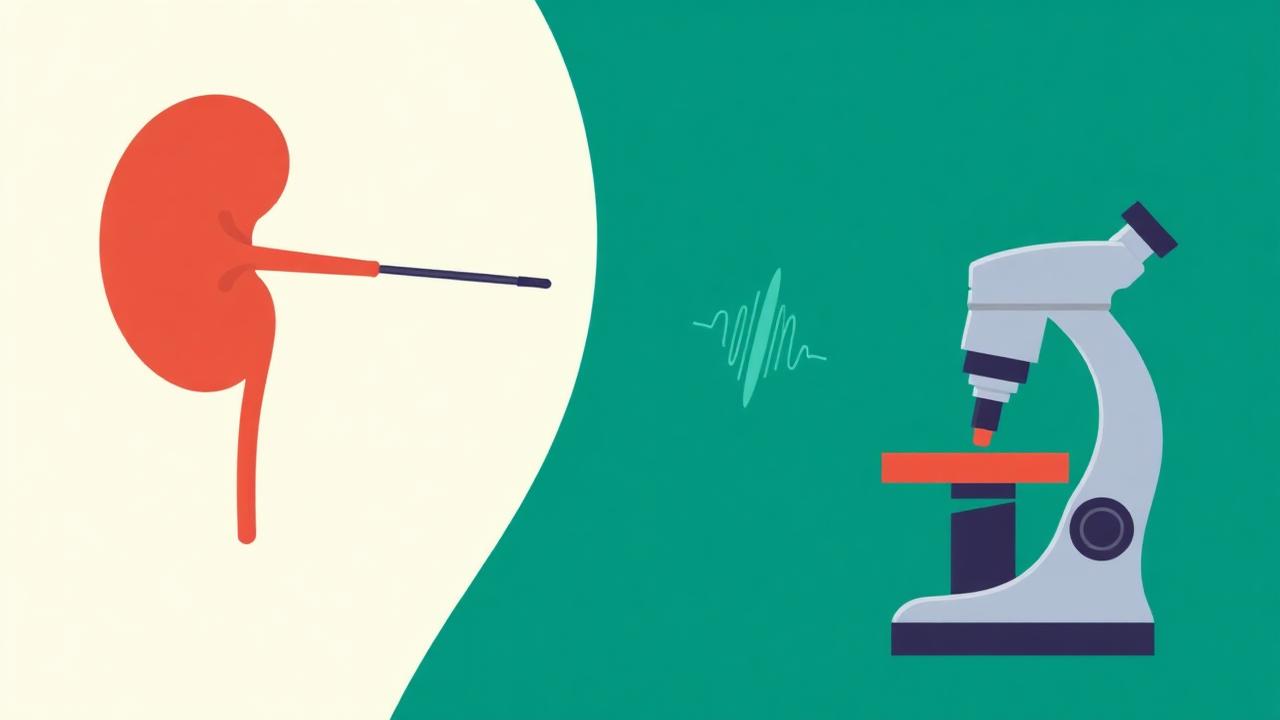
A kidney biopsy takes a tissue sample about the size of a pencil lead and examines it under a microscope. Blood and urine tests show that something is wrong; a biopsy usually shows exactly what — and that determines the right treatment.
The reason
Why might a biopsy be advised?
A biopsy is recommended when the result will change your treatment or clarify your outlook — not routinely.
Significant protein leaking into urine
Unexplained blood in the urine
Kidney function falling without a clear cause
Suspected immune or autoimmune kidney disease
Problems with a transplanted kidney
To judge how much damage is reversible
The procedure
What actually happens
The whole procedure usually takes 15 to 30 minutes. You stay awake, and local anaesthetic keeps it comfortable.
- 01
Before: preparation
Blood clotting tests and blood pressure are checked. Blood thinners and some painkillers are stopped several days in advance — always confirm timings with your doctor.
- 02
Positioning
You lie on your front (or on your back for a transplant kidney). Staying still and following simple breathing instructions is all that is asked of you.
- 03
Ultrasound guidance
An ultrasound locates the safest spot on the kidney and guides the needle in real time throughout the procedure.
- 04
Taking the sample
After local anaesthetic, a fine needle takes one or two small cores of tissue. You feel pressure and a brief click rather than sharp pain.
- 05
After: observation
You rest lying flat for several hours while pulse, blood pressure and urine are monitored. Most people go home the same day or the next morning.
- 06
Analysis
The sample is examined by light microscopy, immunofluorescence and often electron microscopy. Preliminary results take a few days; the full report can take one to two weeks.
Safety
How safe is it?
Kidney biopsy is a well-established procedure and serious complications are uncommon. Bleeding is the main risk, which is why observation afterwards matters.
Some blood in the urine for a day or two afterwards is expected and not a cause for alarm. Heavy bleeding, clots or severe pain are not, and need immediate review.
What to expect and watch for
- Mild soreness at the site for a few days
- Slight blood in the urine, briefly
- A small bruise around the kidney (common, harmless)
- Significant bleeding — uncommon
- Need for transfusion — rare
- Need for a procedure to stop bleeding — very rare
Recovering at home
Simple precautions for the first two weeks help the kidney heal fully.
The value
What the result gives you
This is why the procedure is worth it: a biopsy replaces uncertainty with a specific answer.
A precise diagnosis, not an assumption
The right treatment, avoiding the wrong one
How much damage is scarring versus active disease
A realistic picture of your outlook
Confidence before starting strong medicines
A baseline for future comparison
When should you seek medical help?
Contact your doctor after a biopsy if you have
- Heavy or persistent blood in the urine
- Blood clots or difficulty passing urine
- Increasing pain in the back or side
- Dizziness or feeling faint
- Fever
Go to hospital immediately for
Severe pain, heavy bleeding, fainting, a racing pulse, or being unable to pass urine at all.
The most important message
A biopsy is a small procedure that often changes everything about how your kidney disease is treated. Understanding why yours is advised makes the decision much easier.
Ask these four questions before your procedure.
If you are concerned about your kidney health, speak with a qualified healthcare professional. This information is for patient education and does not replace individual medical advice.